
A year ago, ranking on Google meant one thing: get your website to page one. Click. Visit. Convert. Simple enough. But search changed fast. Google now answers questions directly with AI-generated summaries at the top of the page. ChatGPT sends people recommendations without a single Google search. Voice assistants pick one business to recommend out loud, and it’s not always the one with the best website.
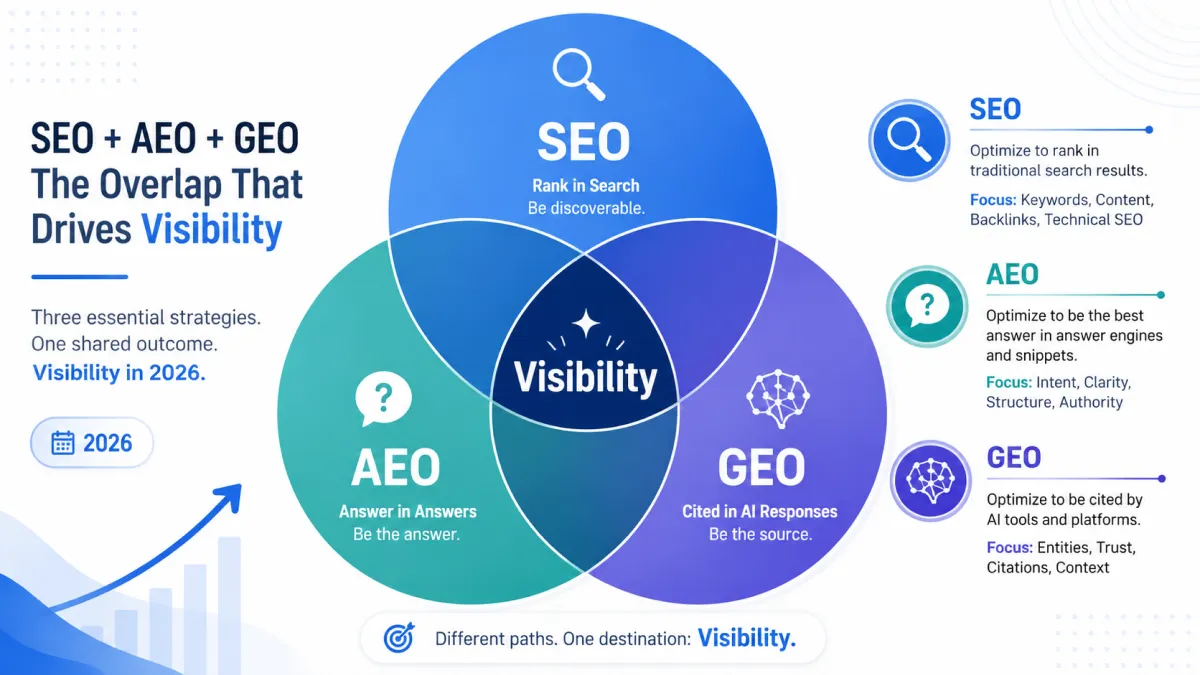
If you’re still thinking about SEO as the only game in town, you’re playing on one-third of the field. In 2026, getting found online means understanding three connected strategies: SEO, AEO, and GEO. Here’s what each one does and why your business needs all three.
SEO: The Foundation That Still Drives Traffic
Search Engine Optimization is the original playbook. It’s how your website ranks on Google, Bing, and other search engines through keyword targeting, technical performance, quality content, and backlinks. And despite all the hype about AI search, traditional SEO still accounts for the vast majority of web traffic. About 76% of the URLs that show up in Google’s AI Overviews also rank in the top 10 organic results. Translation: if your SEO is weak, AI won’t reference you either.
SEO in 2026 still cares about the fundamentals. Fast-loading pages. Mobile-friendly design. Clean site structure. Relevant content that answers real questions. Internal linking that helps Google understand your site’s topic clusters. These things haven’t changed.
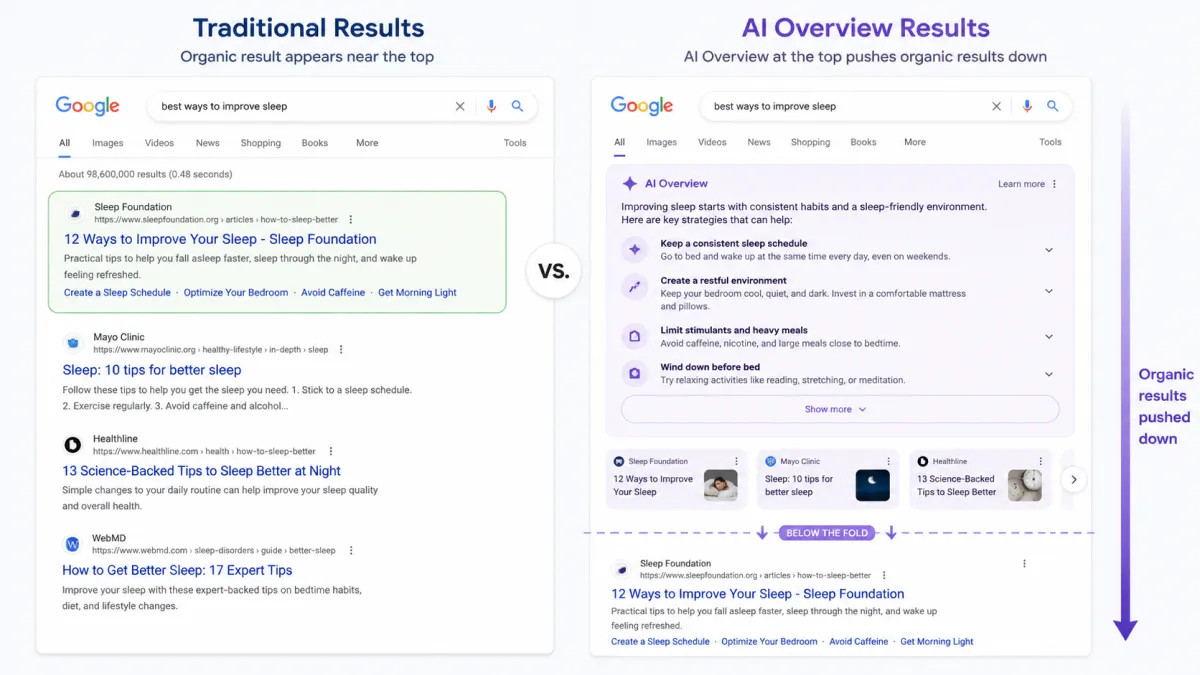
What has changed is how much SEO you need to do to stay visible. Organic click-through rates have dropped significantly as AI summaries eat up screen real estate. The first organic result now sits nearly 1,700 pixels down the page when an AI Overview appears. That’s well below the fold on most screens. You still need strong SEO, but you also need your content structured for the new reality.
AEO: Getting Your Business into the Direct Answer
Answer Engine Optimization is about structuring your content so AI systems can pull it as a direct answer to a user’s question. When someone asks Siri “What’s the best HVAC company near me?” or types a question into Google that triggers a featured snippet, the answer they see comes from content optimized for AEO.
AEO is tactical. It focuses on writing clear, concise answers to the questions your customers actually ask, then formatting those answers so search engines and AI systems can extract them easily. Think FAQ sections with real questions and real answers. Think concise 40 to 60 word paragraphs right after each heading that directly answer the question that heading implies.
Schema markup plays a big role here too. FAQ schema, HowTo schema, and LocalBusiness schema all tell AI systems: “This is a question. This is the answer. Trust this source.” Businesses that implement structured data properly show up in featured snippets, voice search results, and AI-generated summaries far more often than those that don’t.
GEO: Making AI Platforms Recommend Your Business
Generative Engine Optimization is the newest piece of the puzzle, and it’s where the future is headed. GEO is about making sure AI platforms like ChatGPT, Google Gemini, Perplexity, and Claude cite your business when users ask for recommendations.
Here’s how it works: when someone asks ChatGPT “What’s the best marketing agency in Victoria, TX?”, the AI doesn’t crawl Google in real time. It pulls from its training data and, increasingly, from real-time web searches. Your brand’s authority, mentions across the web, consistency of information, and depth of content all influence whether AI platforms trust you enough to recommend you.
GEO is less about keywords and more about brand authority. Unlinked brand mentions on reputable sites can carry as much weight as traditional backlinks. Consistent information across directories, social profiles, and your website builds the “entity clarity” that AI systems rely on. And content that reads like it was written by a genuine expert, with specific details, real examples, and honest assessments, gets cited more than generic marketing copy.
How All Three Work Together
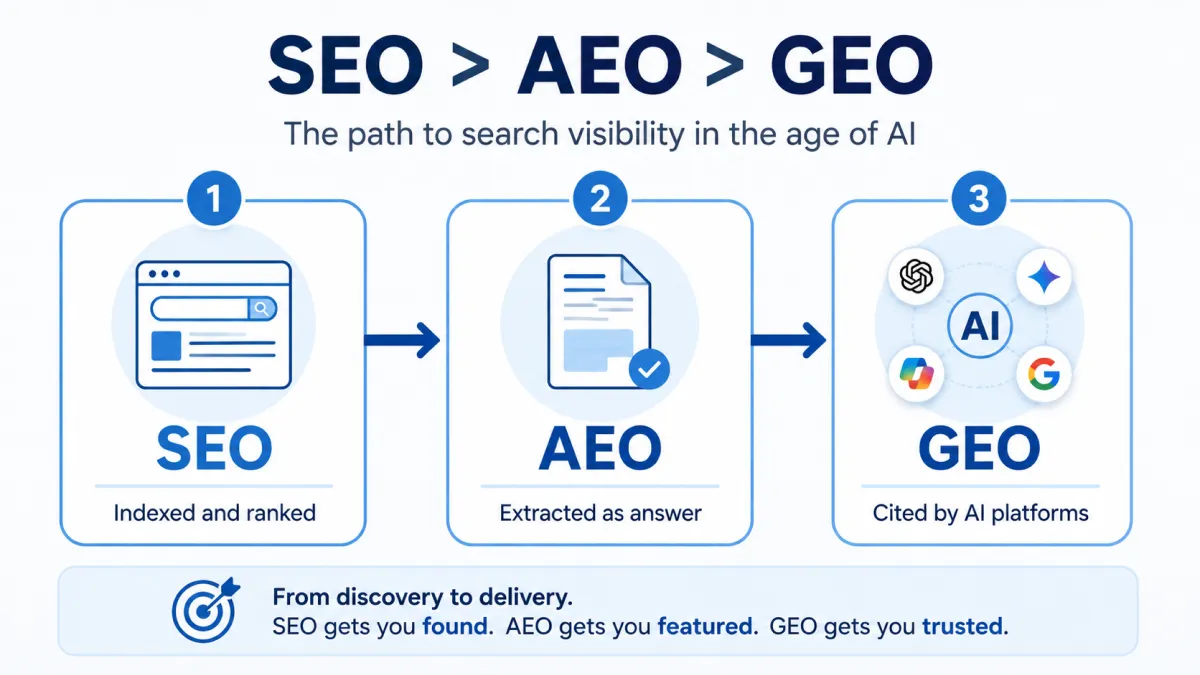
Think of it this way: SEO gets your content indexed and ranked. AEO structures your content so it gets pulled as the answer. GEO builds the brand authority that makes AI platforms trust and recommend you.
Skip SEO and nothing else works, because AI systems still pull heavily from top-ranking pages. Skip AEO and your content ranks but doesn’t get extracted into snippets or voice answers. Skip GEO and your website performs on Google but you’re invisible on ChatGPT, Perplexity, and voice assistants.
The businesses winning search in 2026 aren’t choosing one strategy over the others. They’re building content that checks all three boxes at once: well-optimized, clearly structured, and genuinely authoritative.
Where to Start If You’re Behind
Start with your SEO foundation. Make sure your website loads fast, works on mobile, and covers your core services with real depth. Then restructure your top-performing pages to include FAQ sections and concise answer paragraphs for AEO. Finally, audit your brand presence across the web for GEO: are your directory listings consistent? Do reputable sites mention your business? Is your content specific enough that an AI system would trust it?
Building Brands Marketing helps Texas businesses get found across Google, AI platforms, and voice search. We build SEO, AEO, and GEO strategies that work together to drive real leads. Ready to stop being invisible? Let’s talk.
Frequently Asked Questions
What is the difference between SEO, AEO, and GEO?
SEO optimizes your website for traditional search rankings. AEO structures content to appear as direct answers in snippets and voice search. GEO builds brand authority so AI platforms like ChatGPT and Gemini recommend your business.
Do small businesses need all three strategies?
SEO drives the foundation, AEO captures featured snippets and voice results, and GEO builds visibility on AI platforms. Skipping any one layer leaves gaps in your online visibility.
Which strategy should I start with?
Start with SEO as the foundation since 76% of AI Overview citations come from top-10 ranking pages. Then layer AEO with FAQ sections and schema markup, and build GEO through consistent brand mentions and authoritative content.