
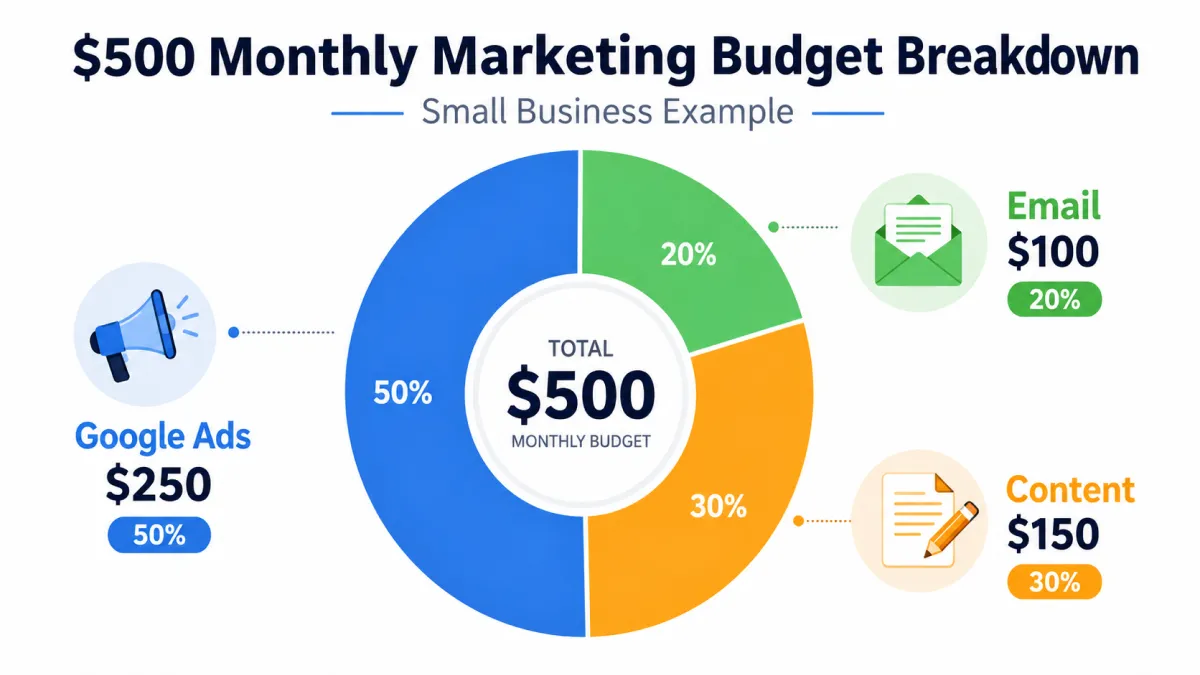
Let’s kill the myth right now: you don’t need $5,000 a month to market your small business. You don’t need a full-time marketing team, a six-figure ad budget, or a viral TikTok strategy. What you need is $500, a clear plan, and the discipline to spend every dollar where it counts.
$500 a month isn’t a lot. But it’s more than enough to build a real marketing engine if you’re strategic about it. Here’s exactly how to allocate that budget across the tactics that deliver the highest return for small businesses in 2026.
Option 1: The Local Service Business Split
If you’re a plumber, roofer, landscaper, attorney, dentist, or any business that serves a local area, here’s how $500 works hardest:
$300 on Google Ads. Target your highest-value service with exact-match and phrase-match keywords in your service area. At an average cost-per-click of $3 to $8 for local services, that’s roughly 40 to 100 clicks per month. With a 10% landing page conversion rate, that’s 4 to 10 leads. If you close 25% of those, that’s 1 to 3 new clients from $300 in ad spend.
$100 on Google Business Profile optimization and content. Post weekly updates, add photos of completed work, respond to every review, and keep your services and hours current. This is free traffic that compounds over time. The $100 covers tools or a freelancer to keep it consistent.
$100 on email marketing. Use a platform like Mailchimp or MailerLite (both have free tiers for small lists) and send two emails per month to your existing contacts and past clients. One educational email, one promotional. Email marketing returns an average of $42 for every $1 spent. Even at a small scale, this channel pulls weight.
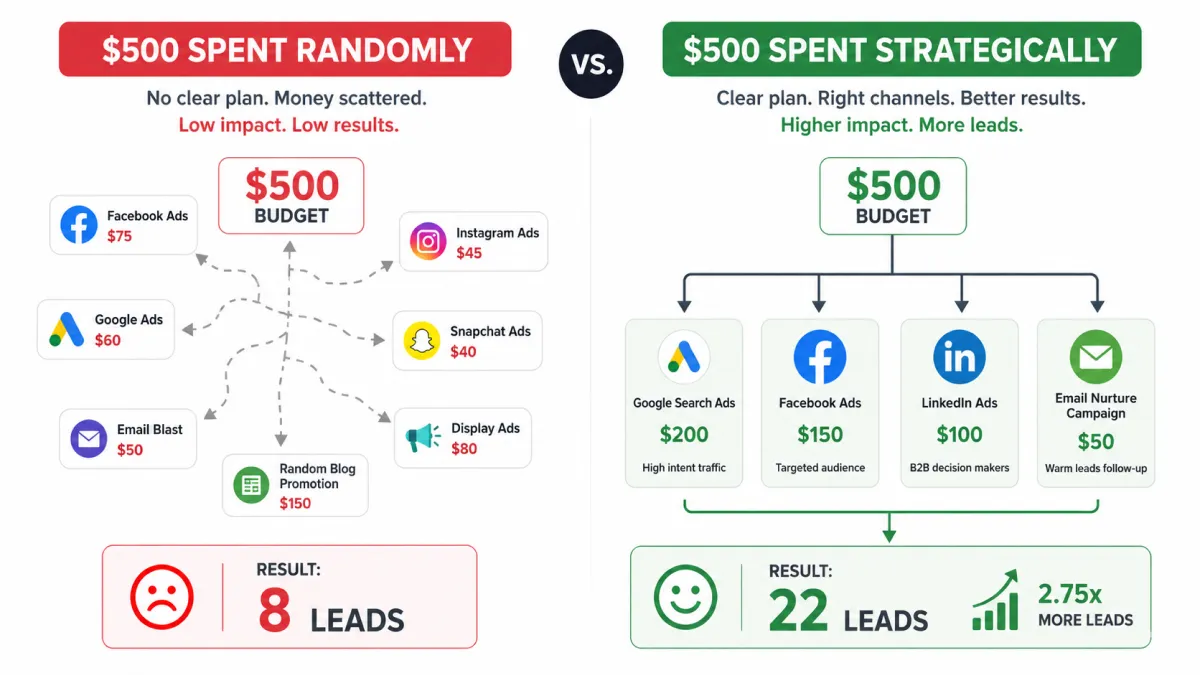
Option 2: The E-Commerce or Online Business Split
If you sell products online or run a service-based business that operates digitally:
$200 on Meta Ads (Facebook/Instagram). Run retargeting campaigns to people who’ve visited your website or engaged with your social content. Retargeting costs a fraction of cold traffic and converts at a much higher rate. $200 can generate 10,000 to 30,000 impressions to warm audiences.
$150 on content creation. Write two blog posts per month targeting long-tail keywords your customers are searching for. Use free tools like Google Keyword Planner and AnswerThePublic to find topics. This builds organic traffic that reduces your ad dependency over time.
$150 on email list growth and automation. Build a lead magnet (a discount, a free guide, a quiz) and drive traffic to it. Set up a 5-email welcome sequence that introduces your brand and drives the first purchase. This turns one-time visitors into repeat buyers.
What $500 Can’t Do (And What to Do About It)
Let’s be realistic. $500 a month won’t flood you with 100 leads. It won’t build brand awareness across an entire metro area. It won’t compete with competitors spending $5,000 on the same keywords. And it won’t produce results overnight.
What it will do is create a measurable, trackable marketing system that generates leads consistently. It’s a foundation. Every dollar you add later amplifies what you’ve already built. The businesses that grow their marketing budgets over time are the ones that started small, proved ROI, and reinvested the returns.
The biggest mistake you can make with $500 isn’t spending it wrong. It’s not spending it at all. Every month you wait to start is a month of compound growth you’ve lost.
Tools That Stretch Your Dollar
At $500 a month, your tool stack needs to be lean. Here’s what we recommend:
Google Ads: Start with $10/day and scale what converts. Use the free Google Ads keyword planner to find affordable keywords.
Mailchimp or MailerLite: Free for up to 500 subscribers. More than enough to start building your email channel.
Google Business Profile: Completely free. The highest-ROI marketing activity for any local business.
Canva: Free plan handles social graphics, email headers, and basic marketing materials.
Google Analytics 4 and Google Search Console: Both free. Together, they tell you where your traffic comes from, what people do on your site, and which keywords you’re ranking for.
ChatGPT or Claude: AI tools can help draft ad copy, brainstorm blog topics, and write email subject lines in minutes instead of hours. Most have free tiers or low monthly costs.
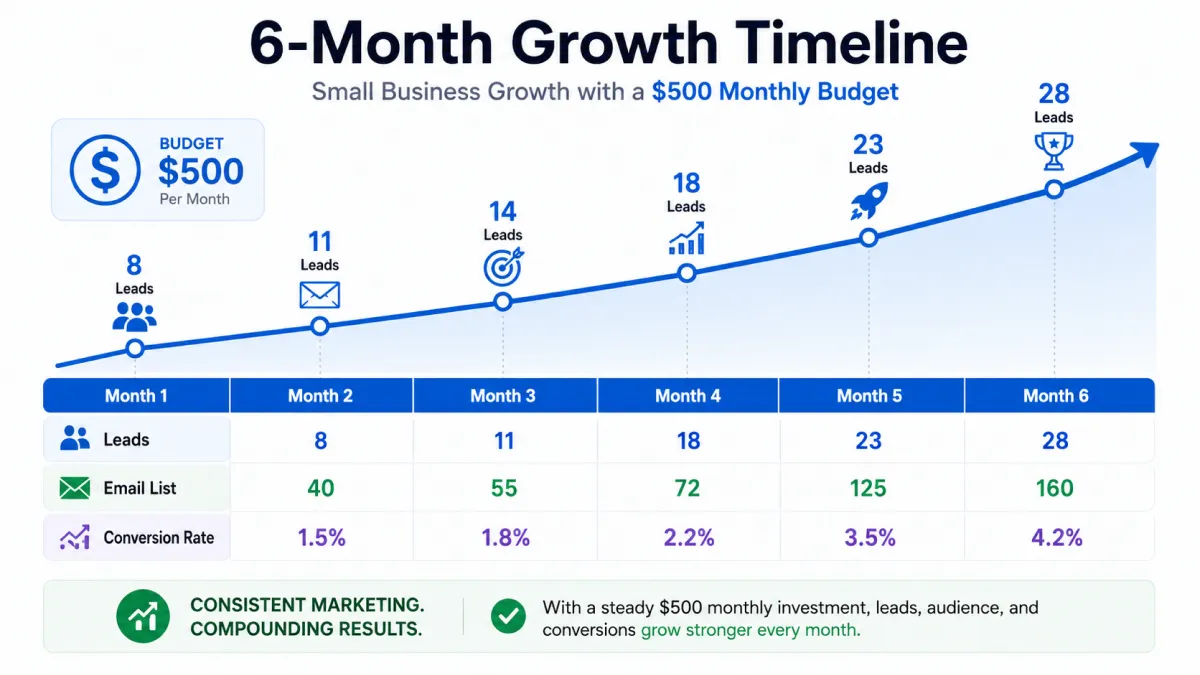
The $500 Month-by-Month Growth Plan
Month 1: Set up tracking, launch your first Google Ads campaign or Meta retargeting campaign, and send your first email. Establish your baseline metrics.
Month 2: Review data. Cut underperforming keywords or audiences. Publish your first blog post. Add a lead magnet to your website.
Month 3: Scale the ad campaigns that are producing leads. Send your second and third emails. Start collecting reviews systematically.
Months 4-6: Your organic traffic should start growing. Your email list should be building. Your ad costs should be dropping as you optimize. By month 6, your $500 should be producing measurably more than it did in month 1.
From there, every additional dollar you invest goes further because the system is built. The hard part isn’t spending $500. The hard part is spending it intentionally. Do that, and the results will follow.
Building Brands Marketing works with small businesses at every budget level. Whether you’re starting with $500 or scaling to $5,000, we build marketing systems that prove ROI before you spend more. No guessing. No wasted dollars. Let’s make your budget work.
Frequently Asked Questions
Is $500 a month enough for small business marketing?
Yes. A strategic $500 budget can generate 4-10 leads per month through Google Ads, build an email channel, and start organic traffic growth that compounds over time.
How should a local business spend $500 on marketing?
Allocate $300 to targeted Google Ads, $100 to Google Business Profile optimization, and $100 to email marketing. This covers immediate lead generation and long-term organic growth.
How long before a $500 marketing budget shows results?
Paid ads can produce leads within the first week. Organic tactics like SEO and email take 3-6 months to compound. By month 6, a well-managed $500 budget should produce measurably more leads than month 1.