
You worked 11 hours yesterday. You answered 47 emails, sat through two meetings, fixed a website issue, posted on social media, and put out a fire with a vendor. And at the end of the day, nothing that actually grows your business moved forward. Sound familiar?
Being busy and being productive are two completely different things. Most small business owners are drowning in tasks that feel urgent but don’t move the needle. The priority matrix is a framework that fixes this. It forces you to sort every task by what actually matters, and it takes about 10 minutes to set up.
What a Priority Matrix Is (and Why It Works)
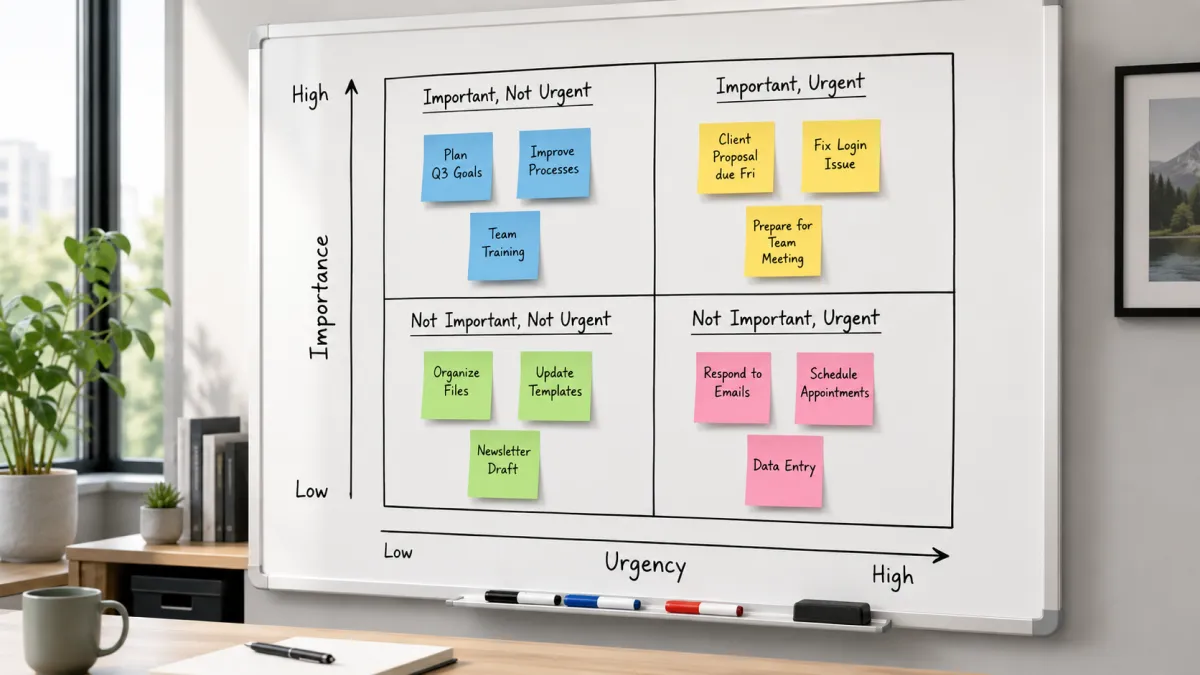
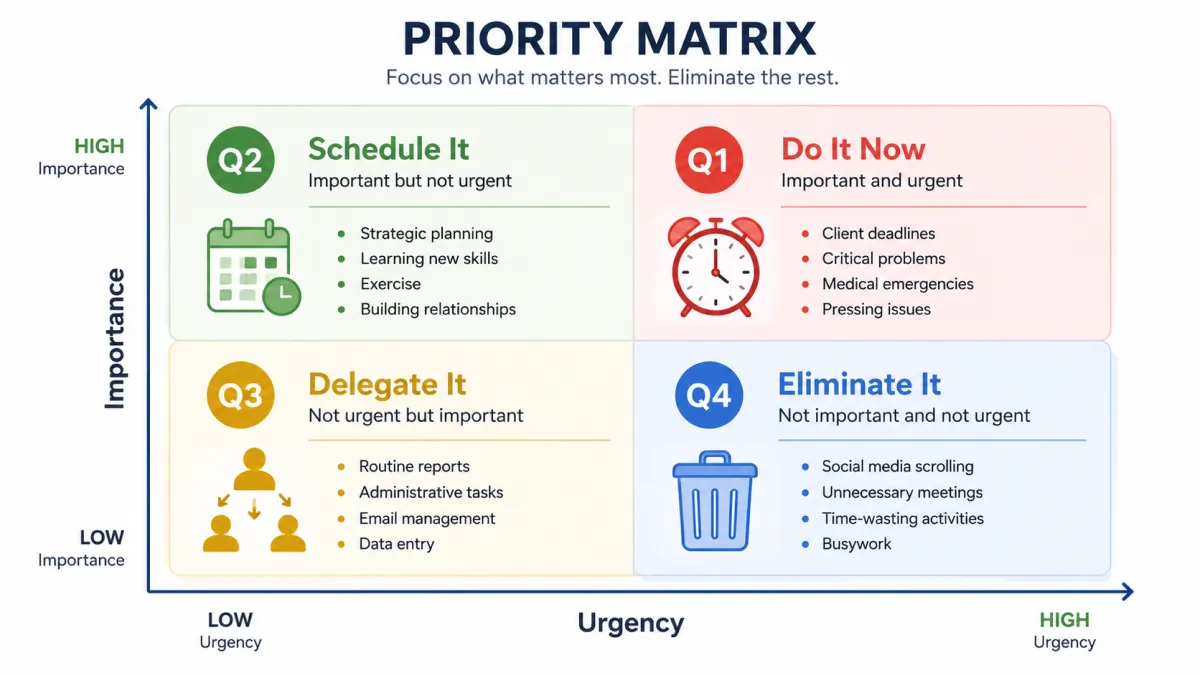
The priority matrix, often called the Eisenhower Matrix, sorts every task into one of four categories based on two questions: Is this urgent? Is this important? That gives you four quadrants:
Quadrant 1: Urgent and Important. These are genuine emergencies and deadlines. A client crisis. A system outage. A proposal due tomorrow. You handle these immediately because they have real consequences if you don’t.
Quadrant 2: Important but Not Urgent. This is where growth lives. Strategic planning. Relationship building. Content creation. Training your team. Process improvement. These tasks don’t scream for your attention, but they’re the ones that compound over time and actually move your business forward.
Quadrant 3: Urgent but Not Important. Most of your email inbox lives here. Phone calls that could be texts. Meetings that could be emails. These tasks demand your attention right now but contribute almost nothing to your goals. They feel productive because they’re fast, but they’re distractions dressed up as work.
Quadrant 4: Not Urgent and Not Important. Scrolling social media. Reorganizing files that don’t need reorganizing. Comparing software tools you’re not going to switch to. These are time fillers. Eliminate them.
Why Business Owners Get Stuck in Quadrant 3
Small business owners spend most of their time in Quadrant 3 because urgency feels like importance. When your phone buzzes, you answer. When an email comes in, you reply. When a team member walks into your office with a question, you stop what you’re doing and help.
None of those are bad instincts. But they add up to a day where you were constantly reactive and never proactive. By 5 PM, you’ve been busy all day but made zero progress on the work that actually generates revenue, attracts new clients, or improves your team’s capability.
The priority matrix breaks that cycle by making you ask, before you do anything: “Is this actually important, or does it just feel urgent?”
How to Set Up Your Priority Matrix
Grab a piece of paper, a whiteboard, or open a blank document. Draw a 2×2 grid. Label the columns Urgent and Not Urgent. Label the rows Important and Not Important. Now write down every task on your plate this week and place it in the correct quadrant.
Most business owners are surprised by what they find. The majority of their tasks land in Quadrant 3 (urgent, not important) while their Quadrant 2 (important, not urgent) sits nearly empty. That’s the problem in black and white.
Spending More Time in Quadrant 2
Quadrant 2 is where the magic happens. This is strategy work. Client relationship development. Building marketing systems that bring in leads while you sleep. Training your team so they can handle problems without you. Writing the proposal for that dream client. These tasks don’t have deadlines because nobody else is imposing them. You have to impose them yourself.
Block time for Quadrant 2 work the way you’d block time for a client meeting. Put it on your calendar. Protect it. Treat it as non-negotiable. Even 90 minutes a day of focused Quadrant 2 work will transform your business within a quarter.
Delegate Quadrant 3, Eliminate Quadrant 4
If a task is urgent but not important, someone else should be handling it. Email responses, scheduling, routine client follow-ups, social media posting: these can be delegated to a team member or automated with tools. Your job as the business owner is not to do everything. It’s to do the things only you can do.
Quadrant 4 tasks are even simpler: stop doing them. If it’s not urgent and not important, it doesn’t belong on your calendar. Period.
The Weekly Reset: 10 Minutes That Change Everything
Every Sunday night or Monday morning, spend 10 minutes reviewing your week through the priority matrix lens. Look at your calendar and your task list. Ask: What’s in Quadrant 2 this week? How much time is blocked for it? What from Quadrant 3 can I hand off? What from Quadrant 4 can I cut entirely?
This single habit, practiced weekly, will give you more clarity and more results than any productivity app or time management course. It’s not about doing more. It’s about doing what matters.
Building Brands Marketing runs on this framework. We help small businesses across Texas stop spinning their wheels and start growing with purpose. If your marketing feels like busy work with no payoff, let’s fix that. Request a free consultation.