
Your neighbor says AI is going to take everyone’s jobs. Your business partner says it’s the future of everything. Your teenager says it’s “mid.” And you’re sitting there wondering what any of it actually means for your business.
Let’s fix that. No computer science degree required. No buzzwords. Just a straight explanation of how AI works, written for business owners who want to understand the tool before they invest in it.
AI Is Pattern Recognition on Steroids
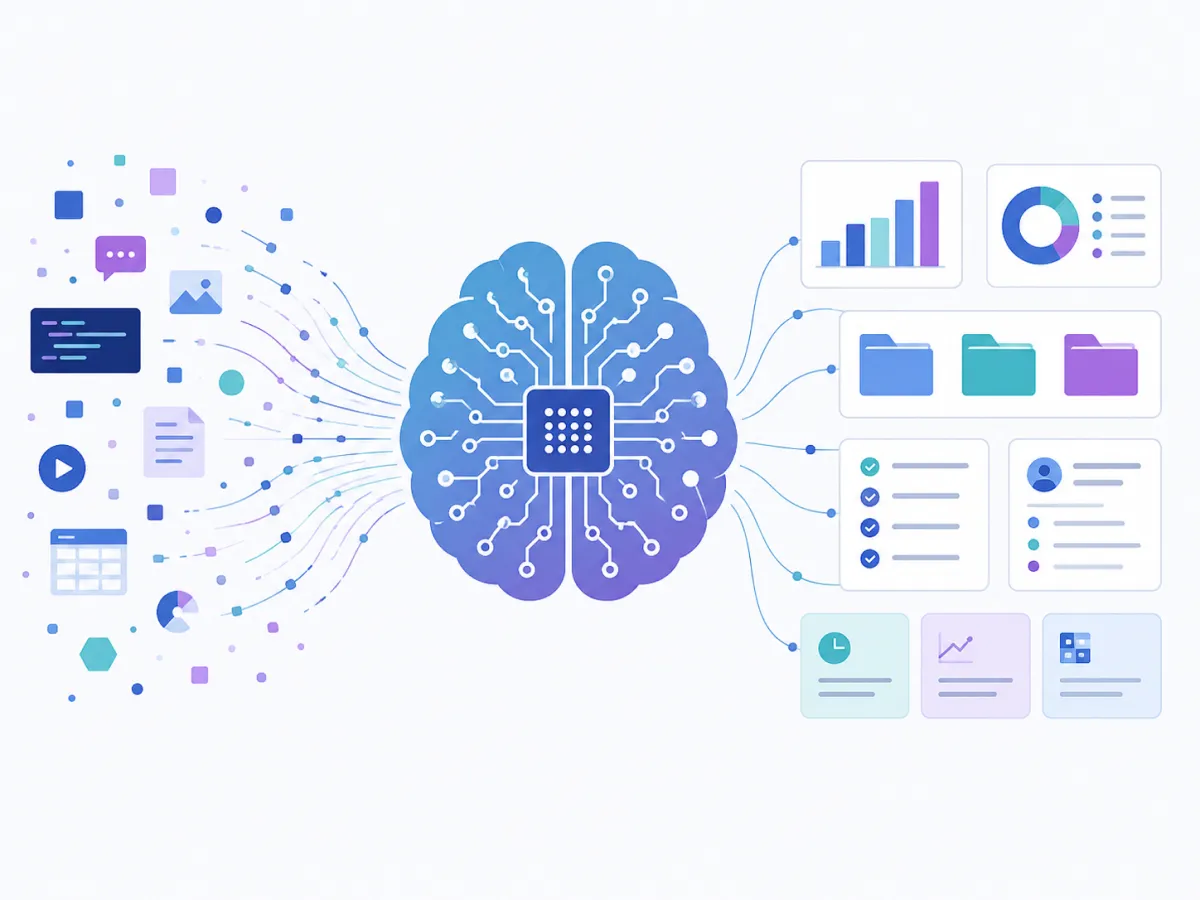
At its core, artificial intelligence is software that finds patterns in massive amounts of data. That’s it. It’s not thinking. It’s not conscious. It’s really, really good at spotting connections humans would miss or take forever to find.
Think about how you hire employees. After interviewing 200 people over 10 years, you develop a gut feeling for who will work out. That gut feeling is pattern recognition. AI does the same thing, except it processes millions of data points instead of 200, and it does it in seconds.
The “Large Language Model” Behind ChatGPT
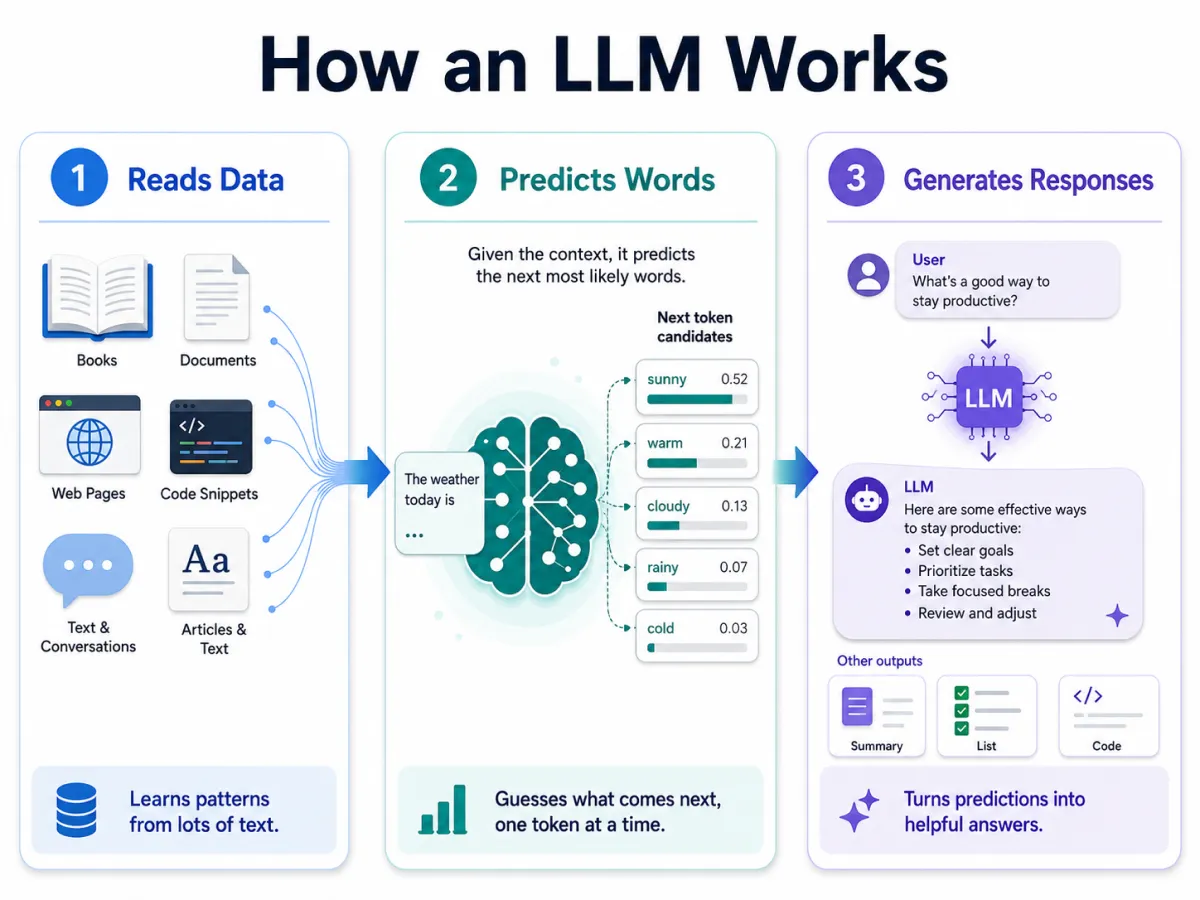
When people talk about ChatGPT or Claude or Gemini, they’re talking about something called a large language model, or LLM. Here’s the plain-English version of how AI works at the LLM level:
Step one: The model reads a massive amount of text. Books, websites, articles, forums. Billions of pages. It doesn’t memorize them word for word. Instead, it learns the relationships between words. It figures out that “dog” is more likely to appear near “bark” and “leash” than near “spreadsheet” and “quarterly earnings.”
Step two: When you type a question, the model predicts the most likely next word, one word at a time. It’s playing the world’s most sophisticated game of autocomplete. “The capital of France is…” and the model calculates that “Paris” is the overwhelmingly likely next word based on everything it’s learned.
Step three: It strings those predictions together into sentences, paragraphs, and full responses that read like a human wrote them. Because it learned from human writing.
Why AI Gets Things Wrong Sometimes
AI doesn’t actually know things the way you know your phone number. It predicts what sounds right based on patterns. Most of the time, those predictions are accurate. But sometimes the patterns lead somewhere wrong, and the model confidently says something completely false. Researchers call this a “hallucination.”
This is why you should never blindly trust AI output. Use it as a starting point, not the final word. A good rule of thumb: if the answer matters (legal advice, medical info, financial numbers), always verify it with a real source.
What “Training” an AI Model Means
You’ve probably heard that AI models are “trained.” This just means the model was fed data and adjusted its internal settings until its predictions got more accurate. Think of it like training a new employee. At first, they make mistakes. You correct them, they adjust, and over time they get better. AI training works the same way, just with math instead of conversations.
The “large” in large language model refers to the size of the model itself. Modern models have billions of internal settings (called parameters) that all work together to predict the next word. More parameters generally means better predictions, but also more computing power and energy to run.
How AI Gets Smarter After Training
After the initial training phase, companies fine-tune their models using human feedback. Real people rate the model’s responses: “This answer was helpful.” “This one was wrong.” “This one was inappropriate.” The model adjusts based on those ratings. This step is what makes modern AI feel conversational and useful rather than robotic.
What This Means for Your Business
AI isn’t magic and it isn’t a threat. It’s a tool that processes language patterns faster and at a larger scale than any human can. That makes it incredibly useful for tasks like drafting content, answering customer questions, analyzing data, and automating repetitive work.
The business owners who win with AI aren’t the ones who understand transformer architecture or neural networks. They’re the ones who understand their own bottlenecks and know where a pattern-recognition tool can save them time and money.
Want to figure out where AI fits in your marketing strategy? Building Brands Marketing helps Texas businesses cut through the hype and build AI-powered marketing systems that actually work. Let’s talk.

Frequently Asked Questions
How does AI actually work?
AI works by recognizing patterns in massive datasets. Large language models read billions of pages of text and learn word relationships, then predict the most likely next word to generate human-sounding responses.
Why does AI sometimes give wrong answers?
AI predicts what sounds correct based on patterns rather than truly knowing facts. When patterns lead to wrong conclusions, the model can confidently produce inaccurate information, called hallucinations.
Do I need to understand AI technically to use it in my business?
No. The business owners who succeed with AI understand their own bottlenecks and match AI tools to those problems. Technical knowledge of how models work is not required.