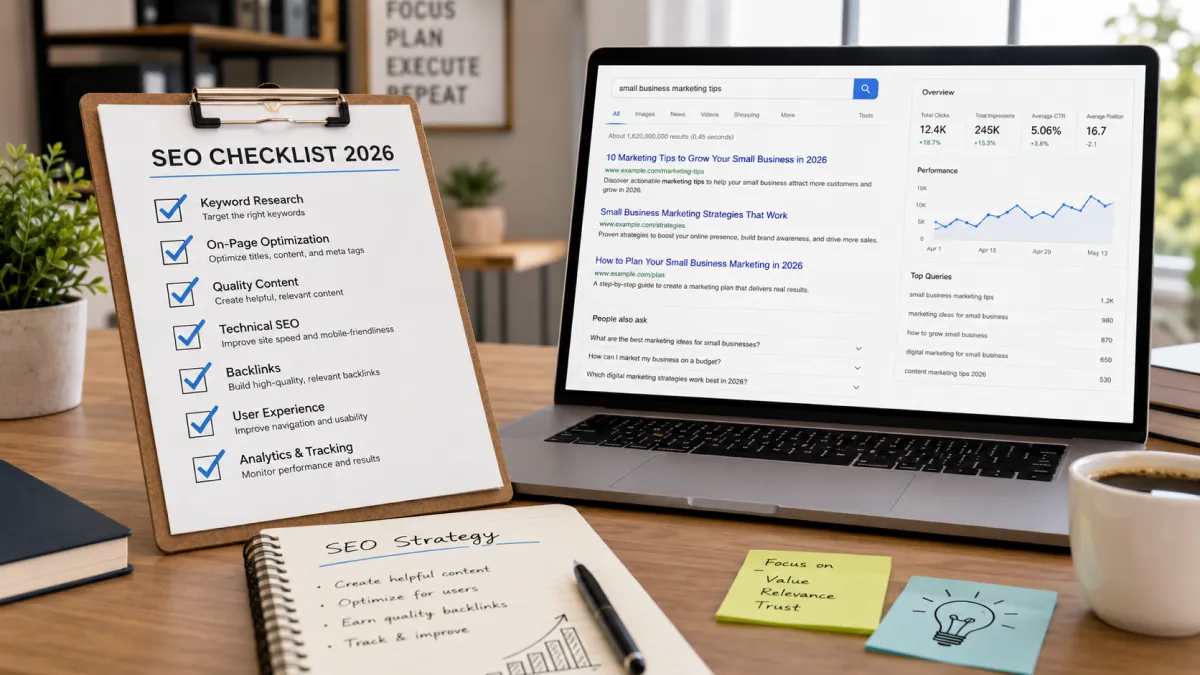
Most SEO checklists are written for marketing agencies. They’re 3,000 words long, full of jargon, and assume you have a team of developers standing by. You don’t. You’re running a business, wearing six hats, and you need to know what actually matters.
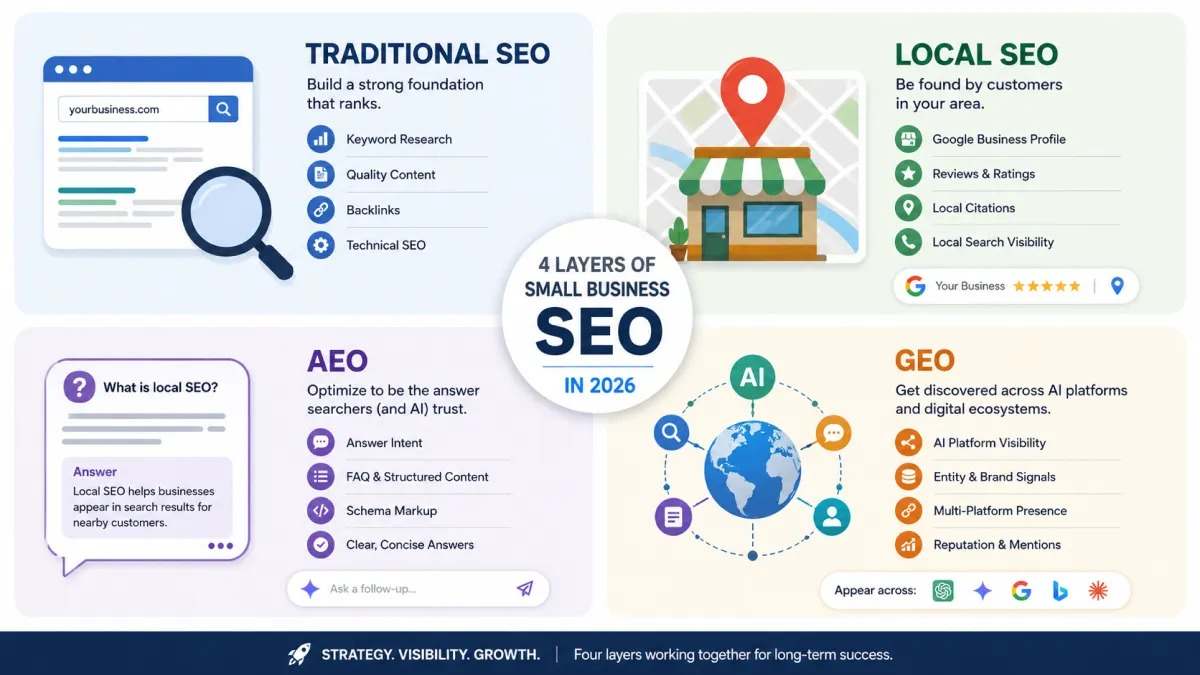
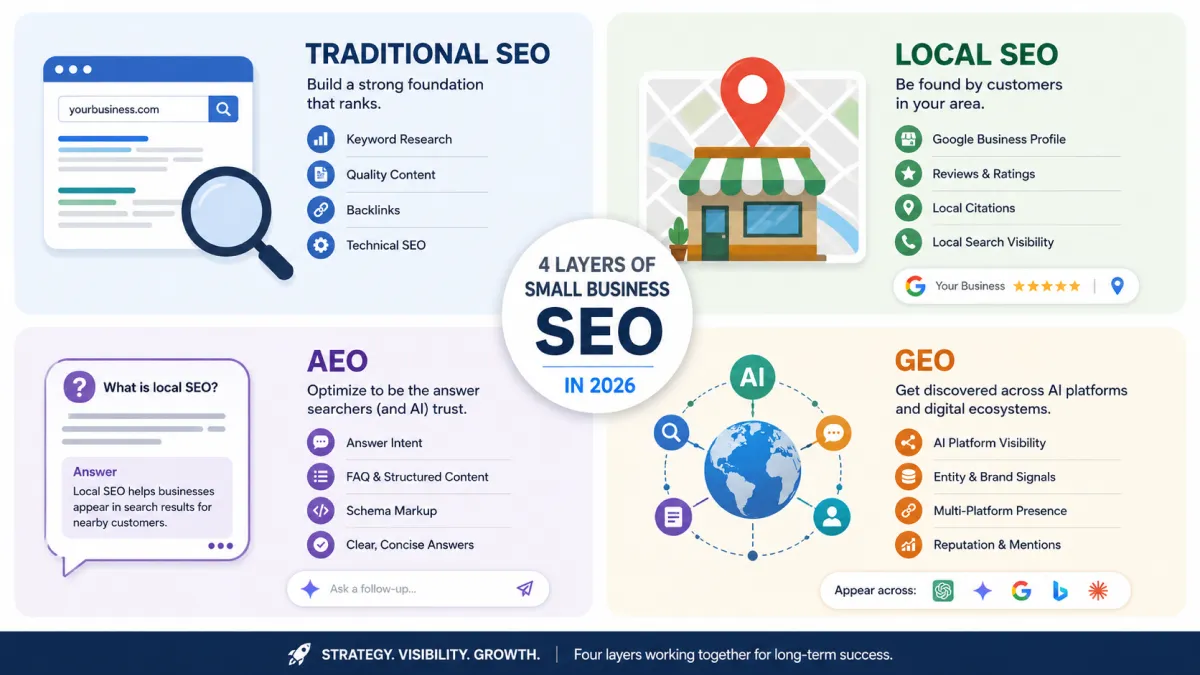
This small business SEO checklist cuts the noise. It covers the four layers of search visibility that drive leads in 2026: traditional SEO, local SEO, AEO (answer engine optimization), and GEO (generative engine optimization). Work through it section by section. Skip what you’ve already done. Focus on what you haven’t.
Traditional SEO: The Foundation
Site speed under 3 seconds. Run your homepage through Google’s PageSpeed Insights. If it takes longer than 3 seconds to load, you’re losing visitors and rankings. Compress images, enable caching, and talk to your hosting provider.
Mobile-friendly design. Google indexes the mobile version of your site first. If your site looks broken or loads slowly on a phone, fix it before anything else. Pull up your site on your phone right now and check.
One page per service. Don’t cram all your services onto one page. Each service should have its own dedicated page with unique content, specific details, pricing ranges, and a clear call to action. This gives Google more pages to rank for more keywords.
Title tags and meta descriptions on every page. Every page needs a unique title tag under 60 characters with your target keyword near the front, and a meta description under 160 characters that sells the click. If your CMS auto-generates these, override them manually.
Internal links between related pages. Link your blog posts to your service pages. Link your service pages to related blog content. This helps Google understand your site structure and passes authority between pages.
2 to 3 blog posts per month. Consistent, helpful content signals to Google that your site is active and authoritative. Write about the questions your customers ask. Use real details from your experience.
Local SEO: Getting Found in Your Area
Google Business Profile fully completed. Every field filled. Every category selected. Services described in detail. Photos uploaded and updated monthly. Posts published weekly. This alone can outperform thousands of dollars in website investment for local visibility.
NAP consistency everywhere. Your business Name, Address, and Phone number should be identical across your website, Google Business Profile, Yelp, Facebook, industry directories, and everywhere else you’re listed. Inconsistency confuses both Google and AI systems.
Review generation system in place. Ask every customer for a Google review. Make it easy with a direct link. Respond to every review within 48 hours. Aim for at least 2 to 3 new reviews per month to keep your review stream fresh.
Location pages with unique content. If you serve multiple areas, create a dedicated page for each one. Don’t just swap city names. Include local details, neighborhood references, and service specifics for each area.
AEO: Getting Pulled as the Direct Answer
FAQ section on every service page. Add 3 to 5 real questions your customers ask, with concise answers of 40 to 60 words each. These are prime candidates for featured snippets and voice search responses.
Answer-first paragraphs after every H2. Start each section with a direct, self-contained answer before expanding with detail. AI systems extract these concise paragraphs for featured snippets and AI Overviews.
FAQ schema markup implemented. Don’t just write FAQ content. Mark it up with FAQ schema so search engines can machine-read your questions and answers. This dramatically increases your chances of appearing in rich results.
HowTo schema on step-by-step content. If you have guides, tutorials, or process pages, implement HowTo schema. Each step should be a complete thought that makes sense on its own.
Natural-language content for voice search. Write content that answers questions the way people actually speak: “How much does it cost to replace a water heater in Victoria, TX?” not just “water heater replacement cost.”
GEO: Getting Recommended by AI Platforms
Consistent brand information across the web. AI systems like ChatGPT, Gemini, and Perplexity cross-reference your information from multiple sources. If your business name, services, or details are inconsistent across directories, your website, and your social profiles, AI platforms lose confidence in recommending you.
Content that demonstrates real expertise. AI systems cite content that includes specific numbers, real examples, verifiable claims, and clear author credentials. Write like someone who does the work, not someone who sells it.
Brand mentions on third-party sites. Get mentioned on local news sites, industry blogs, community pages, and business directories. In GEO, unlinked brand mentions carry significant weight with AI systems that don’t rely on traditional backlinks.
Respond to every Google and Yelp review. AI systems analyze your review responses as trustworthiness signals. Consistent, thoughtful responses build the reputation data that AI uses to make recommendations.
The Order of Operations
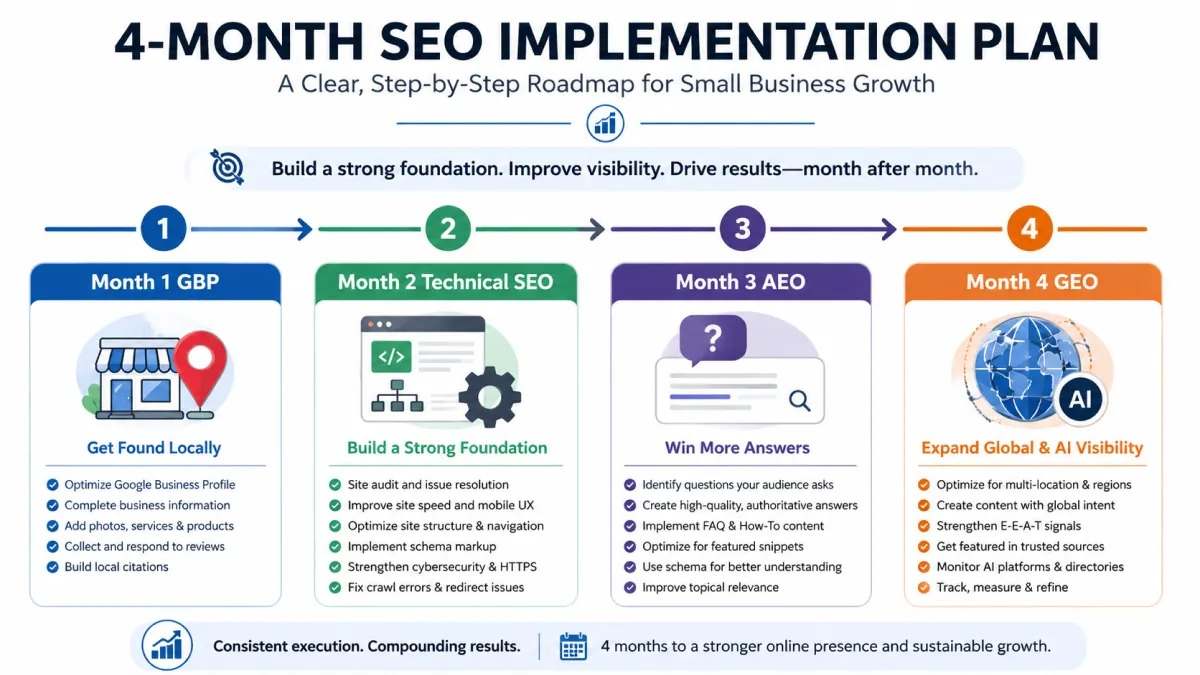
Don’t try everything at once. Here’s the sequence that works for most small businesses:
Month 1: Fix your Google Business Profile. Complete every field, upload photos, start posting weekly, and set up a review generation system.
Month 2: Audit and fix your website’s technical SEO. Page speed, mobile performance, title tags, meta descriptions, and internal linking.
Month 3: Add FAQ sections and schema markup to your top service pages. Write answer-first content for AEO.
Month 4: Build your GEO presence. Audit directory listings for consistency, earn brand mentions, and start publishing content that AI systems want to cite.
Repeat and expand from there. Each layer builds on the last.
Building Brands Marketing runs this exact playbook for small businesses across Texas. We audit where you stand, prioritize what matters most, and execute the strategy that drives calls and leads. Let’s build yours. Request a free consultation today.