How many Google reviews do you need to rank on Google Maps? Do you need a website with hundreds of backlinks? How much organic traffic can a local business generate, and how long does it take to achieve meaningful results?
These are common questions among business owners considering local SEO. However, the answers are not always straightforward.
Our analysis of Google Places results for “plumbing services in Boston” revealed that businesses with thousands of reviews do not necessarily occupy the highest positions. Some businesses achieved first-page visibility with fewer than 20 reviews, while one appeared despite having an inaccessible website and no detectable organic keyword rankings in SEMrush.
In this article, we examine these real-world results to understand what businesses actually need to compete in local search.
What Is Local SEO?
Local search engine optimization (SEO) is the process of improving a business’s online visibility for geographically relevant searches.
Unlike traditional SEO, which may target national or international audiences, local SEO focuses on reaching potential customers within specific cities, neighborhoods, or service areas.
Examples of local searches include:
- Plumbing services in Boston
- SEO agency in Dubai
- Family lawyer in Tampa
- Emergency electrician near me
- Real estate agents in London
Local SEO helps businesses gain visibility across Google Maps, Google’s Local Pack, Google Places results, and traditional organic search results.
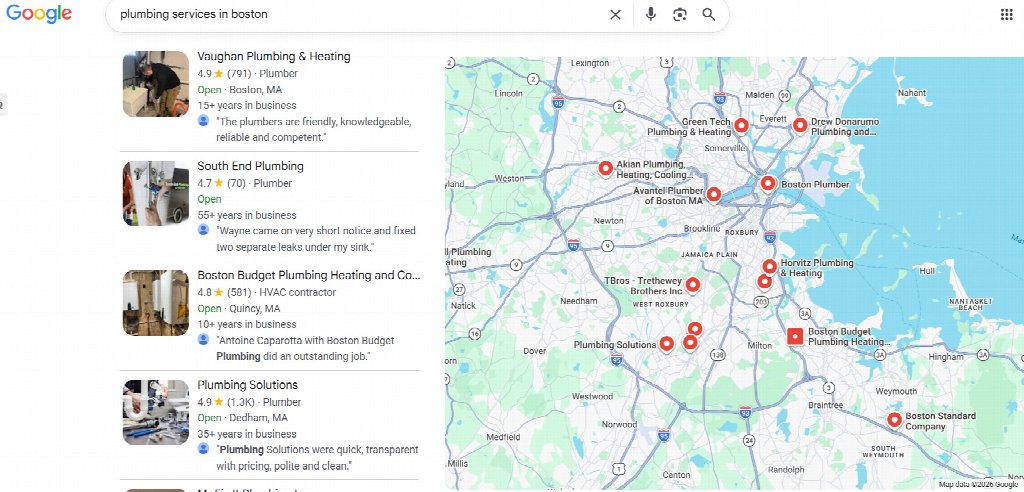
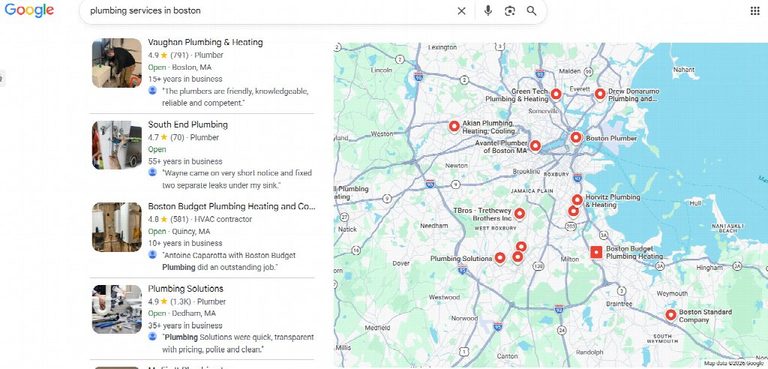
Google Places results for “plumbing services in Boston,” displaying sponsored listings, local businesses, and their geographic locations.
How Does Google Determine Local Search Rankings?
According to Google’s official local ranking guidelines, three primary factors determine local rankings:
| Ranking factor | Description |
| Relevance | How closely a business matches the user’s search query. |
| Distance | How far a business is from the location associated with the search. |
| Prominence | How well-known a business is, supported by signals such as backlinks, reviews, and ratings. |
Google does not disclose the exact weighting of these factors or establish minimum requirements for reviews, backlinks, or website traffic.
To understand how these factors work together, we analyzed a competitive local search market.
Real-World Local SEO Research
Below, we analyzed 20 non-sponsored businesses appearing on the first page of Google Places results for “plumbing services in Boston.”
We examined their Google ratings, review counts, ranking positions, and selected Business Profile characteristics. We also analyzed the websites and backlink profiles of the first and last businesses using SEMrush and Majestic.
The results revealed several interesting patterns.
| Metric | Minimum | Average | Maximum |
| Google rating | 4.6 | 4.86 | 5.0 |
| Google reviews | 17 | 699 | 3,400 |
Additional findings:
- 30% of businesses had fewer than 100 reviews.
- 20% had at least 1,000 reviews.
- 30% had a perfect five-star rating.
- The median review count was approximately 272.
- The business with the most reviews ranked 14th.
- The business with the fewest reviews ranked 15th.
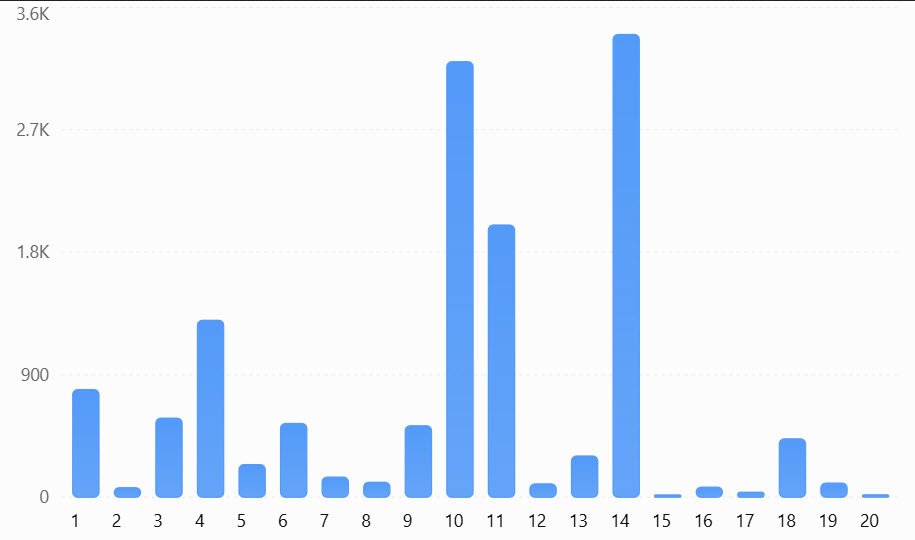
Distribution of Google reviews across the first 20 non-sponsored Google Places results for “plumbing services in Boston.” Businesses with more reviews do not necessarily rank higher.
The second-ranked business had only 70 reviews and a 4.7-star rating, outperforming several businesses with thousands of reviews and higher ratings.
These findings demonstrate that review quantity and rating alone do not determine ranking positions.
The research represents a single search snapshot rather than a controlled ranking experiment. Local results can change depending on the searcher’s location, search settings, time, and competition. Abbreviated review counts also mean that some calculated figures are approximate.
1. How Many Google Reviews Do You Need to Rank?
One of the most common misconceptions about local SEO is that businesses need hundreds of reviews before they can compete.
Our Boston research demonstrates otherwise.
The first-ranked business had 791 reviews and a 4.9-star rating. The last business on the first page had just 18 reviews and a perfect five-star rating.
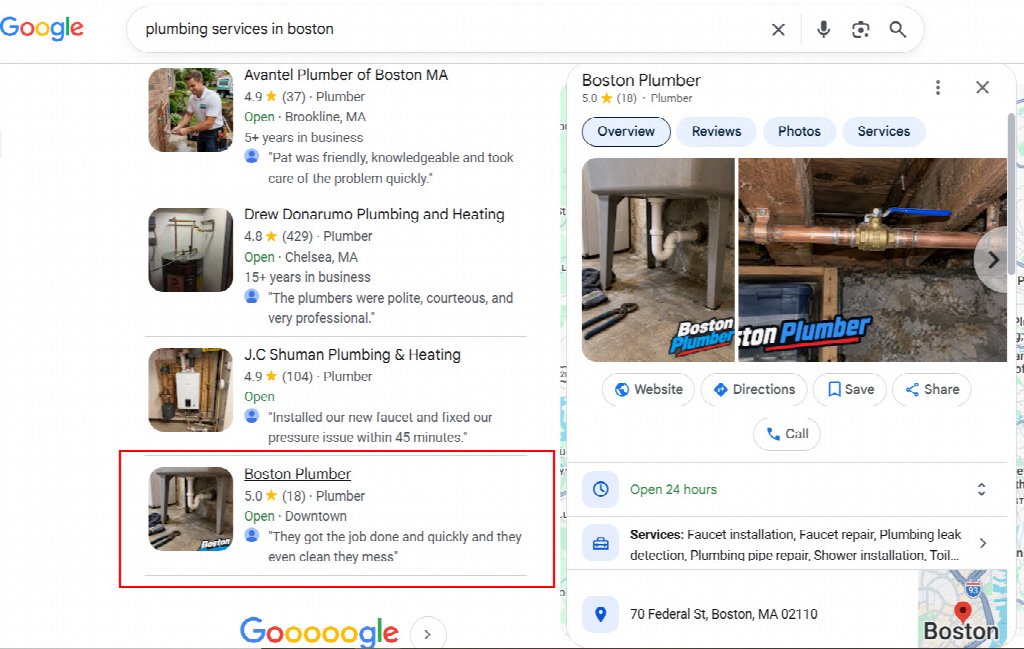
A plumbing business with only 18 Google reviews and a five-star rating achieves first-page visibility for a competitive local search query.
Although the average review count was approximately 699, the median was considerably lower at 272. Several businesses with thousands of reviews increased the overall average.
For a new business competing in a similar market, the following milestones could serve as practical planning targets rather than Google ranking requirements:
| Review count | Practical objective |
| 10–20 | Establish an initial customer reputation. |
| 20–50 | Build a more credible business profile. |
| 50–100 | Develop a stronger competitive reputation. |
| 100–300 | Approach the median review volume in the analyzed market. |
| 300–800+ | Compete more closely with many established businesses. |
There is no universal minimum or maximum number of reviews required to rank. Competitive benchmarks vary by industry and location.
Businesses should focus on consistently generating genuine reviews, maintaining customer satisfaction, and responding professionally to feedback. Avoid purchasing reviews or offering incentives in exchange for them.
2. Do You Need a Website to Rank on Google Maps?
A website is not mandatory for an eligible business to create a Google Business Profile or appear on Google Maps.
Our research provides an interesting example.
The business ranking 20th had a website that returned a connection timeout during our test. SEMrush detected no organic keyword rankings or estimated organic traffic for its domain.
Nevertheless, the business appeared on the first page of Google Places results for a competitive commercial query.
This demonstrates that local search visibility is possible without a currently accessible or organically visible website. However, a connection timeout during a single test does not establish that the website is permanently unavailable.
Ranking and generating business are also different objectives.
A well-developed website allows businesses to:
- Rank for additional service-specific and location-specific keywords.
- Generate traffic from traditional organic search.
- Present case studies, pricing information, and customer testimonials.
- Convert visitors into inquiries, appointments, and sales.
- Build backlinks and strengthen online authority.
- Support discovery across AI-powered search platforms.
Businesses can begin building local visibility without a website, but developing one remains a valuable long-term investment.
3. How Many Backlinks Do You Need for Local SEO?
Backlinks contribute to a business’s online prominence, but how many are necessary to compete in local search?
We compared the domains associated with the first and last businesses in our Boston research.
SEMrush domain comparison
| Metric | Position #1 | Position #20 |
| Authority Score | 28 | 2 |
| Referring domains | 4,700 | 95 |
| Backlinks | 12,300 | 143 |
| Organic keywords | 490 | None detected |
| Estimated monthly organic traffic | 2,100 | N/A |
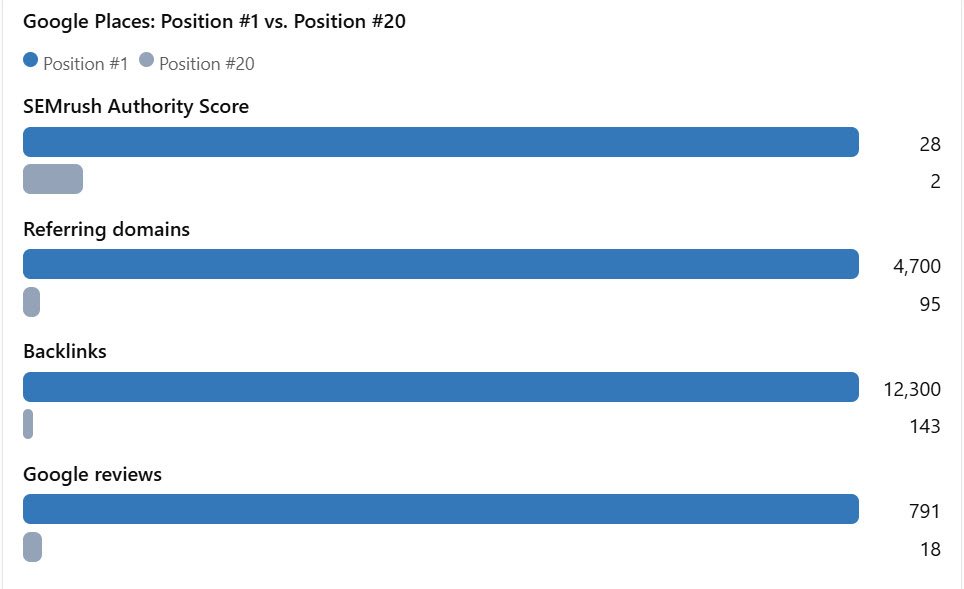
Comparison of website authority, backlink profiles, and Google reviews between the first and twentieth-ranked local businesses. Source: SEMrush and Google Places, November 24, 2026.
The first-ranked business had approximately 49 times as many referring domains and 86 times as many backlinks as the twentieth-ranked business.
Despite this substantial difference, both appeared on the same page of Google Places results.
Majestic domain comparison
| Metric | Position #1 | Position #20 |
| Trust Flow | 3 | 0 |
| Citation Flow | 8 | 0 |
| Referring domains | 63 | N/A |
| External referring URLs | 202 | N/A |
SEMrush and Majestic use different backlink databases and methodologies, which explains why their reported figures may differ substantially.
Furthermore, Authority Score, Trust Flow, and Citation Flow are third-party metrics, not Google’s own ranking scores. Missing backlink data in one tool does not necessarily mean that a website has no backlinks.
There is no established minimum backlink requirement for Google Maps rankings. Instead of targeting an arbitrary number of backlinks, businesses should focus on earning relevant links and mentions from:
- Local business directories and chambers of commerce.
- Industry-specific publications and associations.
- Regional news websites.
- Business partners and suppliers.
- Local events and sponsorships.
A reasonable starting objective could be securing 10–20 relevant referring domains and business mentions, then expanding based on competitor research. This is a campaign planning target, not a proven ranking threshold.
4. Optimize Your Google Business Profile
Google Business Profile (GBP), formerly Google My Business, is central to an effective local SEO campaign.
Create or claim your profile, complete Google’s verification process, and ensure that your business information is accurate.
Important areas include:
- Official business name.
- Primary and secondary business categories.
- Business address or service areas.
- Opening hours and contact information.
- Website URL, if available.
- Products and services.
- Business description.
- Authentic photographs and videos.
Business categories and services
In our Boston sample, 18 of the 20 businesses (90%) used “Plumber” as their displayed category. The remaining two used “HVAC contractor” and “Heating contractor.”
Both the first and twentieth-ranked businesses used the “Plumber” category and listed numerous relevant services, including faucet installation, plumbing pipe repair, leak detection, and water heater installation.
These similarities highlight the importance of accurately categorizing a business and describing its services, although neither guarantees a particular ranking position.
Avoid adding unnecessary keywords or locations to your business name. Follow Google’s Business Profile guidelines and select categories that accurately represent your business.
5. Understand the Importance of Geographic Proximity
Local SEO differs from traditional SEO because the physical location of a business can significantly affect its visibility.
A company may rank well in one neighborhood but struggle to appear for the same keyword in another part of the city.
Our Boston research included businesses from Downtown Boston, Dorchester, Quincy, Dedham, Somerville, Chelsea, Brookline, and other surrounding areas.
Interestingly, the twentieth-ranked business displayed a Downtown Boston location, while the first-ranked business listed an address on Westinghouse Plaza in Boston.
Being located closer to the city center does not automatically guarantee higher rankings. Google considers the location associated with the search alongside relevance and prominence.
Adding additional cities to your Business Profile’s service areas does not automatically improve rankings in those cities.
Businesses should use legitimate operating locations and avoid creating profiles for ineligible virtual offices or locations where they do not operate.
6. How Much Organic Traffic Can Local SEO Generate?
The first-ranked business in our research had an estimated 2,100 monthly organic visits worldwide, including approximately 1,900 from the United States, according to SEMrush.
Its website ranked for 490 organic keywords globally, including 469 in the United States.
The twentieth-ranked business had no detectable organic traffic or keyword rankings in the same tool.
This highlights the difference between Google Maps visibility and traditional website SEO.
A business can generate phone calls, direction requests, and inquiries directly from Google Maps without generating substantial website traffic.
Conversely, a well-optimized website can attract additional visitors through hundreds of service-related and informational searches.
Estimating potential traffic and leads
Rather than relying on universal traffic benchmarks, businesses should calculate opportunities based on local search demand, competition, and expected conversion rates.
Consider the following illustrative scenario:
| Monthly website visits | Assumed conversion rate | Potential inquiries |
| 100 | 5% | 5 |
| 500 | 5% | 25 |
| 1,000 | 5% | 50 |
| 2,000 | 5% | 100 |
These figures are hypothetical planning scenarios, not measured conversion rates from the analyzed businesses.
Direct calls and other interactions generated through Google Business Profile may provide additional leads.
The actual opportunity should be calculated using keyword research, geographic ranking data, website analytics, and Business Profile performance reports.
7. How Long Does Local SEO Take?
Local SEO results depend on competition, business location, existing reputation, website quality, and the resources available for optimization.
The organic traffic history of the first-ranked plumbing business provides useful context.
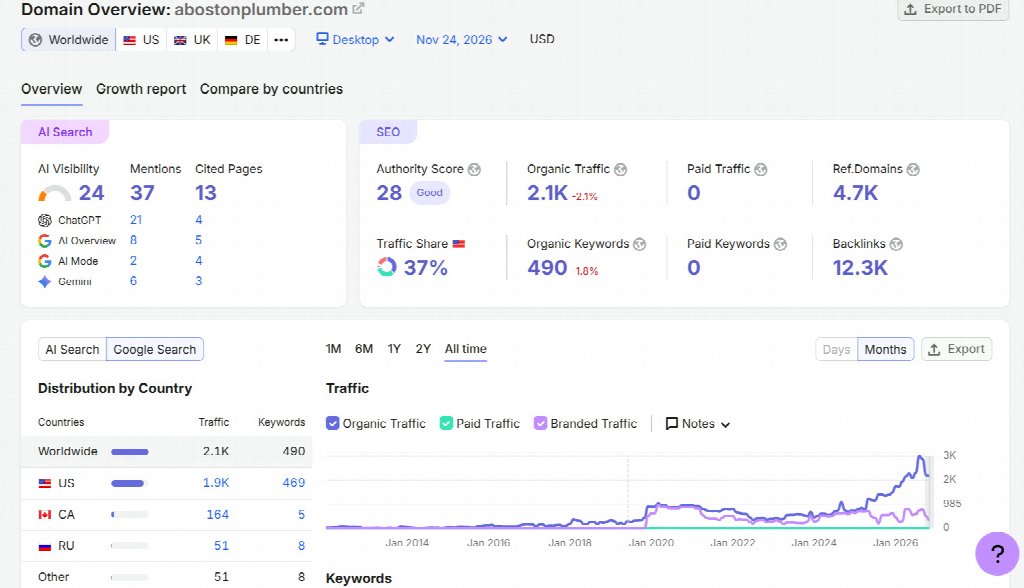 Historical organic traffic estimates for the first-ranked plumbing business, showing long-term website visibility growth and approximately 2,100 estimated monthly organic visits.
The website’s organic visibility developed over several years, with more substantial growth during 2025–2026.
This does not establish how long the business took to achieve its current Google Maps rankings. However, it illustrates how website organic visibility can develop over an extended period.
For businesses starting a local SEO campaign, the following planning framework may be useful:
| Period | Primary objectives |
| Month 1 | Local SEO audit, GBP optimization, keyword research, and baseline reporting. |
| Months 2–3 | Website improvements, business listings, review acquisition, and initial backlink development. |
| Months 3–6 | Expand service content, build local authority, and evaluate early ranking and lead improvements. |
| Months 6–12 | Strengthen competitive visibility, expand keyword coverage, and improve conversions. |
| 12+ months | Maintain rankings, grow authority, and expand into additional markets where feasible. |
These are indicative campaign stages rather than guaranteed ranking timelines.
Less competitive markets may respond faster, while competing against established businesses in major cities may require longer-term investment.
8. Build a Website That Supports Local Growth
Although a website is not mandatory for Google Maps visibility, it can substantially expand a business’s organic search opportunities.
An effective local business website should include:
- Dedicated pages for important services.
- Location-specific pages where appropriate.
- Optimized title tags, headings, and meta descriptions.
- Clear contact information and calls to action.
- Genuine customer testimonials and case studies.
- Relevant internal links and LocalBusiness structured data.
- Good mobile usability and loading performance.
Publish useful content addressing local customer needs, such as pricing guides, common problems, regional requirements, and practical advice.
Avoid creating dozens of nearly identical location pages where only the city name changes. Each page should provide genuine value to its intended audience.
Social media, local partnerships, and industry publications can also help build brand awareness and reach potential customers.
9. Monitor Performance and Adjust Your Strategy
Local SEO should be measured through business outcomes rather than ranking positions alone.
Track the following metrics:
| Metric | Recommended tool |
| Google Maps rankings across locations | Geographic rank-tracking tools |
| Organic clicks and impressions | Google Search Console |
| Website traffic and conversions | Google Analytics 4 |
| Call clicks and direction requests | Google Business Profile |
| Website clicks from GBP | Google Business Profile |
| Reviews and average ratings | Google Business Profile |
| Backlinks and referring domains | SEMrush, Majestic, or similar tools |
Track branded and non-branded keywords separately. A business appearing for its own name does not necessarily have sufficient visibility for generic commercial searches.
Use geographic rank tracking to measure visibility across different neighborhoods rather than relying on a single search.
Final Thoughts: What Do You Actually Need to Rank Locally?
Our analysis of 20 businesses competing for “plumbing services in Boston” demonstrates that there is no universal formula for Google Maps rankings.
Businesses achieved first-page visibility with as few as 17 reviews. One business appeared despite an inaccessible website during our test and no detectable organic keyword rankings. Meanwhile, businesses with thousands of reviews did not necessarily occupy the highest positions.
However, the first-ranked business combined a strong customer reputation, relevant Business Profile information, an established website, and a considerably larger backlink profile.
The practical approach is to start with the essentials: an eligible and optimized Google Business Profile, accurate business information, relevant categories and services, genuine customer reviews, and consistent performance monitoring.
Then, invest in website optimization, content development, and local authority to expand your visibility and generate more qualified leads.
Local SEO is not about reaching a predetermined number of reviews or backlinks. It is about building a competitive online presence that helps customers discover, trust, and choose your business.
About the author
Anatolii Oslovskyi is a Senior SEO Engineer at Rankability SEO LLC, a UAE-based SEO and digital marketing agency. He helps brands grow through social media, organic search, and paid search. You can follow him on X (formerly Twitter): https://x.com/seomonkua.